Call Center Forecasting 101: How to Forecast Volume and Staff a Scaling Contact Center
Call Center Forecasting 101: How to Forecast Volume and Staff a Scaling Contact Center
When I first started staffing a rapidly scaling contact center, our forecasts looked great on paper. Historical averages lined up, service levels penciled out, and the math said we were covered. Then reality showed up.
A sales promotion hit earlier than expected. A new feature launch confused customers more than anyone anticipated. A holiday landed on a different weekday than last year. Suddenly queues spiked, agents were overwhelmed, and leaders were asking how we missed it.
The problem was not the math. It was the assumptions.
Call center forecasting breaks down most often when teams treat the future like a slightly modified version of the past. That approach fails fast when you are scaling a new team, launching new products, or driving demand through marketing. This guide walks through the fundamentals of call center forecasting, the pitfalls to avoid, and how to build forecasts that hold up when things get peaky.
Key Definitions
Before diving deeper, it helps to align on a few core terms used in call center forecasting. These definitions make the rest of the process much easier to reason about.
- Contact volume: The number of inbound contacts, such as calls, chats, or emails, expected in a given time period.
- Interval: A fixed slice of time used for forecasting and staffing, commonly 15 or 30 minutes.
- Average handle time (AHT): The average time an agent spends handling a contact, including talk time and after contact work.
- Service level: A target that defines how quickly contacts should be answered, such as 80 percent of calls answered within 30 seconds.
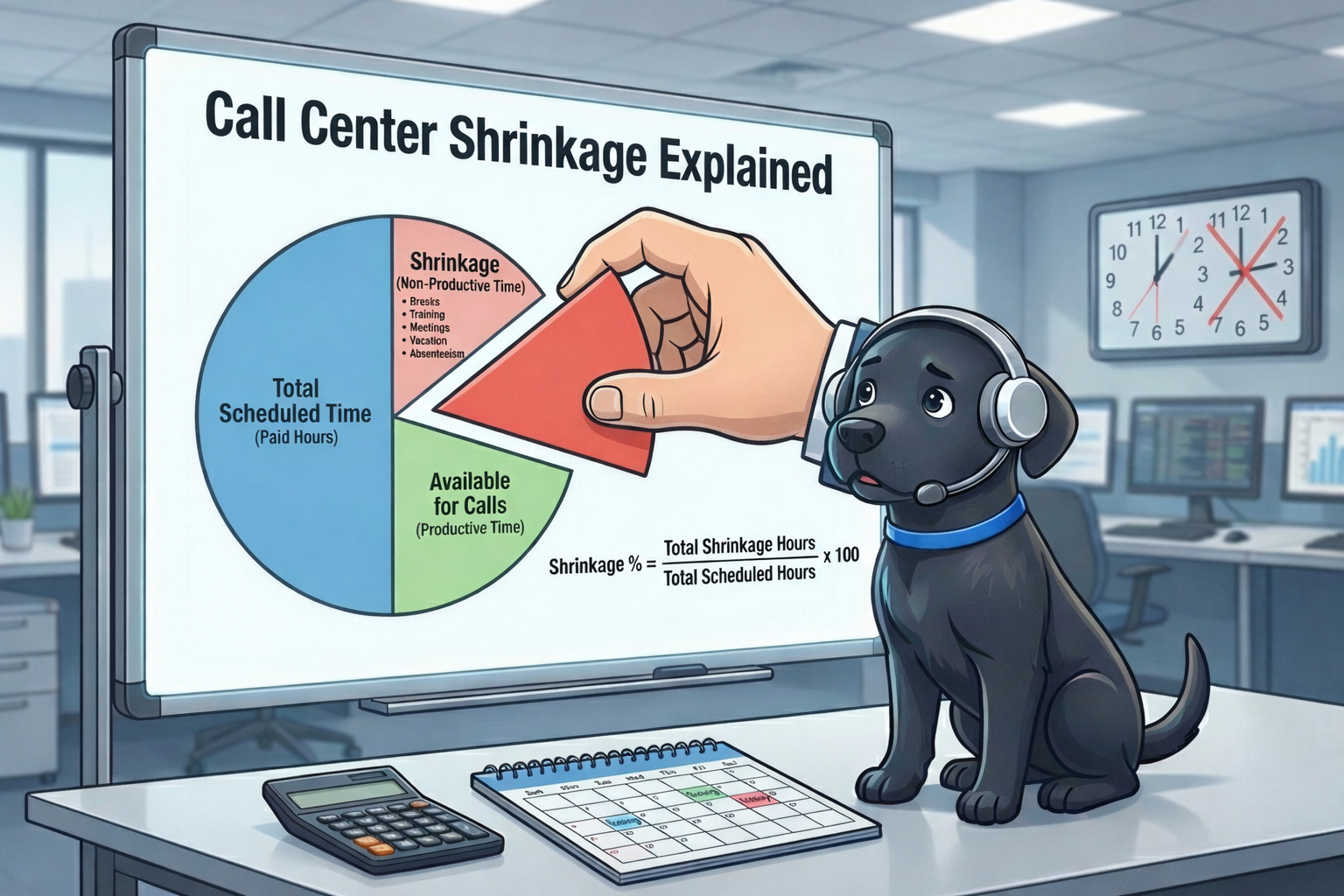
- Shrinkage: The percentage of paid time agents are unavailable to handle contacts due to breaks, training, meetings, attrition, or time off.
- Base headcount: The number of agents needed to handle typical demand outside of peak intervals.
- Peak headcount: The number of agents required during the busiest intervals on the busiest days.
What Is Call Center Forecasting
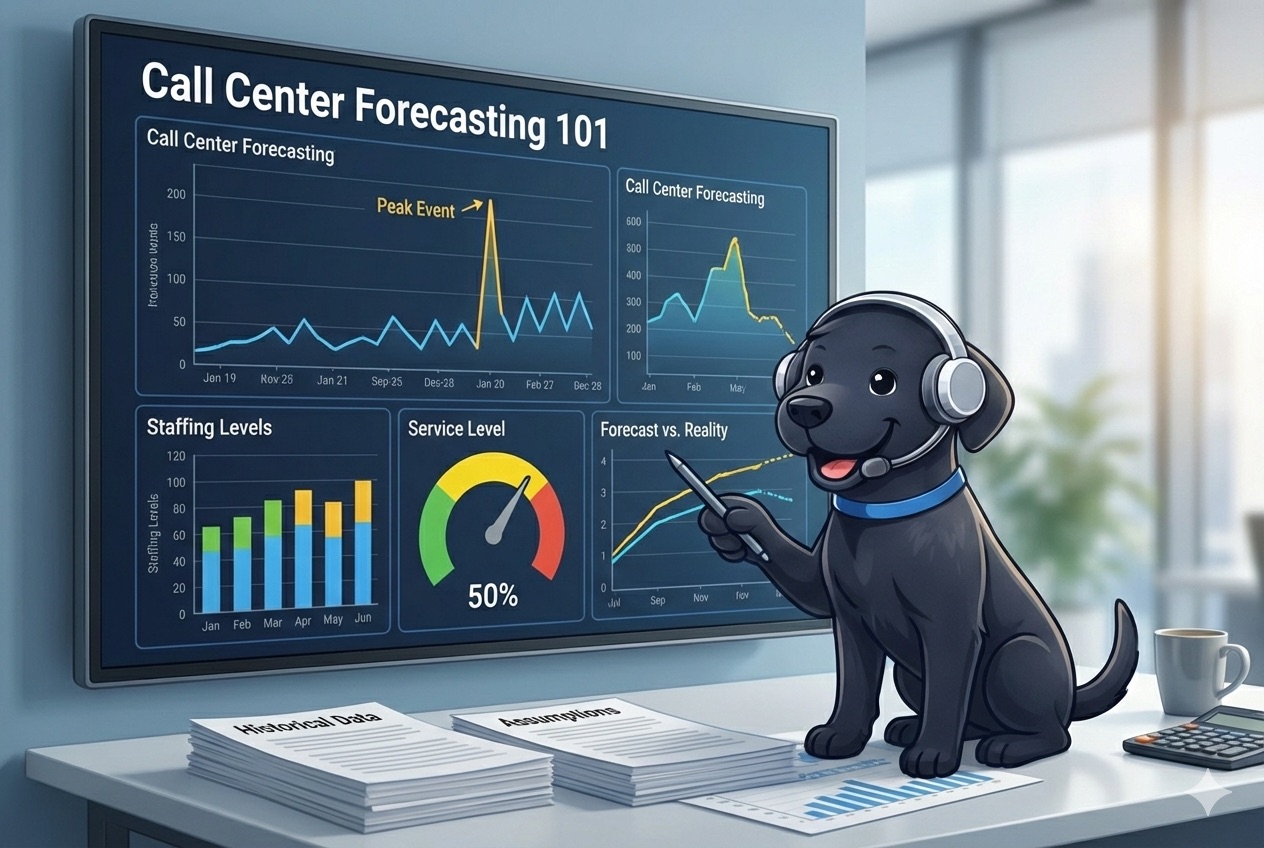
Call center forecasting is the process of predicting future contact volume and handle time so you can staff the right number of agents at the right times.
- How many contacts will arrive
- When those contacts will arrive
- How long agents will spend handling them
Forecasting is the foundation of workforce management. If your forecast is off, every downstream decision suffers, including staffing, scheduling, service levels, and cost.
The Core Inputs You Need to Forecast Call Volume
Historical Contact Volume
Historical volume shows how demand behaved in the past. Look at daily, weekly, and intraday patterns rather than monthly totals.
Average Handle Time
Handle time should be treated as a range. It often increases during launches, promotions, and outage events.
Intraday and Day of Week Patterns
Forecasts that ignore intraday patterns almost always under staff peak hours.
Shrinkage
Underestimating shrinkage is one of the fastest ways to miss service targets.
Business Context
Promotions, holidays, feature launches, policy changes, and pricing updates all change customer behavior. Historical data alone will not capture these effects.
Common Call Center Forecasting Methods
Historical Averages
Easy to calculate, but they smooth out peaks and hide volatility.
Year Over Year Comparisons
Helpful for seasonality, but risky when your product or customer mix is changing.
Trend Based Forecasting
Works best for steady growth and struggles with sudden step changes.
Interval Level Forecasting
Forecasting at the interval level is essential for accurate staffing.
The Biggest Forecasting Pitfalls to Avoid
- Ignoring peaky events: Promotions, launches, and holidays rarely behave like normal days.
- Treating new teams like mature ones: Variability is higher when teams are new.
- Assuming handle time is static: AHT changes with complexity and tenure.
- Forecasting at too high a level: Monthly averages hide intraday risk.
- Forgetting shrinkage: Small errors compound quickly.
Forecasting Starts With the Peak
One of the most important mental shifts for forecasters is to stop thinking in averages and start thinking in peaks.
Start with a simple question: what is my busiest interval on my busiest day?
Breaking demand into base headcount and peak headcount makes staffing decisions far clearer.
- Base headcount covers typical demand
- Peak headcount covers spikes during promotions, launches, holidays, or outages
Once peak requirements are clear, teams can evaluate options like part time staffing, outsourcing with BPO partners, or asking leadership and other teams to help during extreme events such as Black Friday.
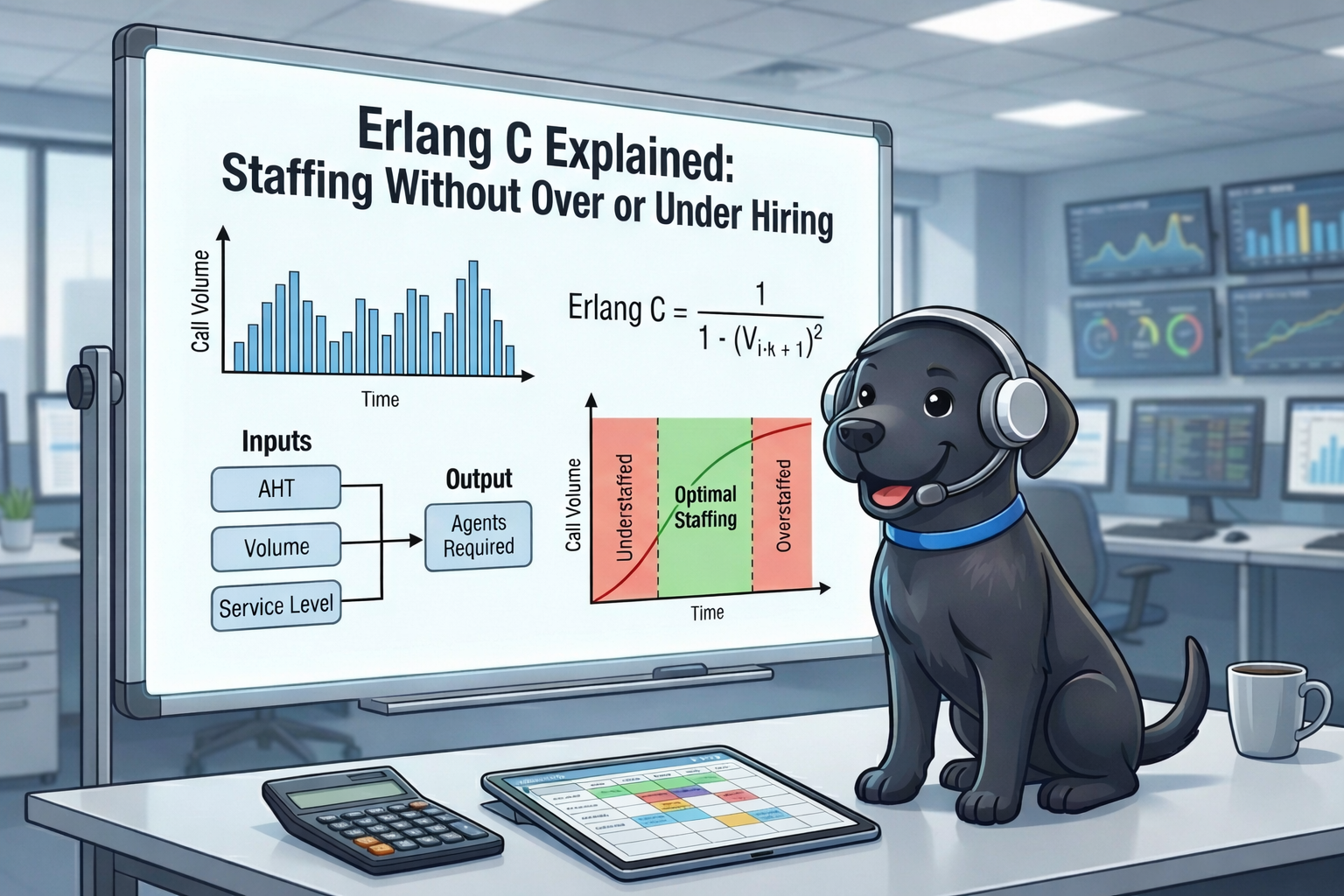
To pressure test peak scenarios, many teams model these intervals directly using an Erlang C calculator so service level and occupancy tradeoffs are visible.
How Erlang C Fits Into Call Center Forecasting
Once volume and handle time are forecasted, models like Erlang C translate demand into required staffing based on service level targets.
Erlang C answers a simple question: given this forecast, how many agents do I need to hit my service level.
It does not fix a bad forecast. Strong assumptions matter more than precise formulas.
From Forecast to Staffing
- Build an interval level forecast with business context
- Adjust handle time and shrinkage for scale risk
- Use an Erlang C calculator to convert demand into headcount
- Review peaks, not just averages
- Re forecast frequently as reality changes
Final Thoughts
Call center forecasting is part math and part judgment. The biggest failures rarely come from the formula. They come from assumptions that ignore how customers behave during peak moments.
A forecast does not need to be perfect. It needs to be honest about uncertainty.