How to Build a Scalable Contact Center Tech Stack
Why scalability breaks
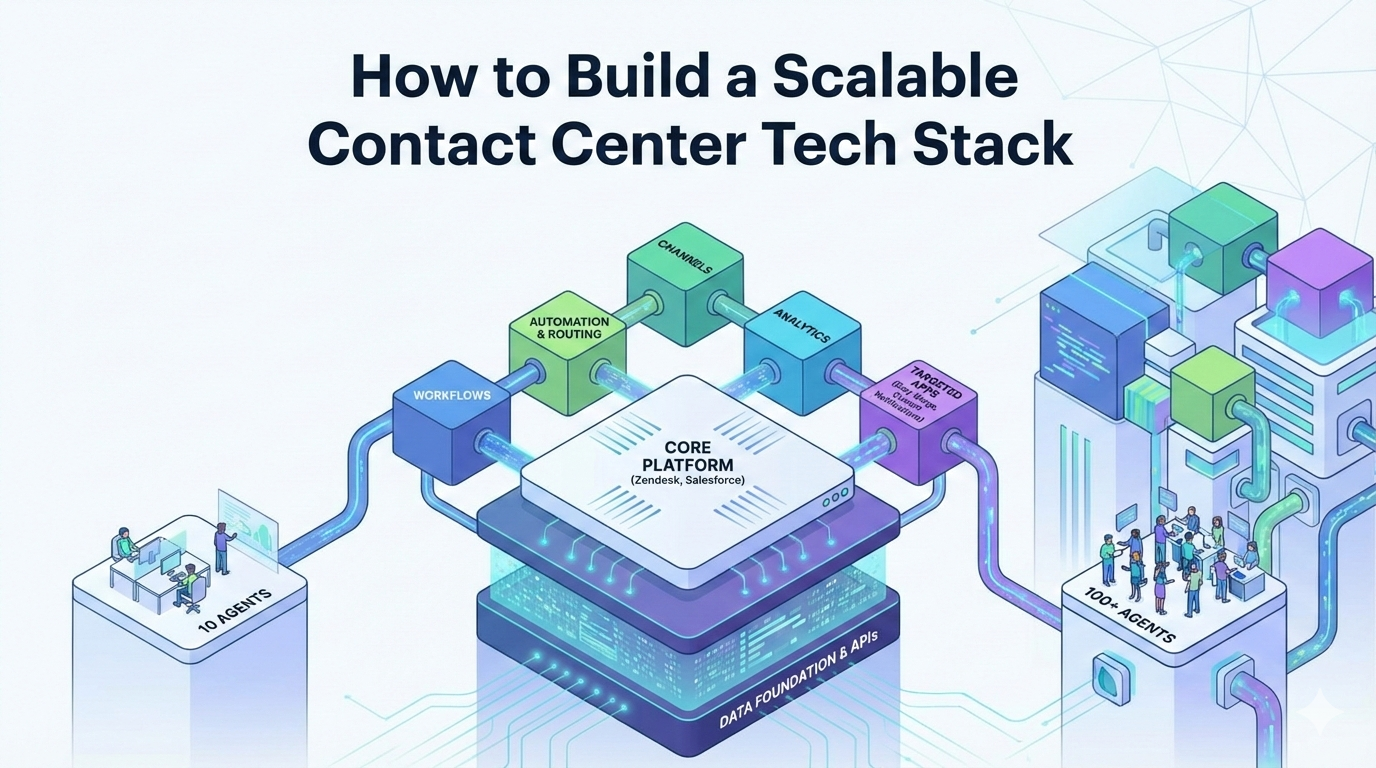
Many contact centers perform well with ten agents and struggle badly at one hundred.
The root cause is rarely hiring or training. In most cases, the problem comes from technology decisions made early, before growth felt real.
A scalable contact center tech stack is not about buying more tools up front. It is about designing for growth without overengineering.
Start with workflows, not software
Before evaluating tools, map the work that actually happens in your contact center.
Focus on the flows that repeat every day:
- Ticket creation and routing
- Escalations and approvals
- Agent collaboration
- Incident and outage response
- Performance monitoring
Your tech stack should support these workflows naturally. If a tool requires workarounds at ten agents, it will become a bottleneck at fifty.
Choose platforms with extensibility
Scalable contact centers rely on platforms, not isolated point solutions.
Tools like Zendesk and Salesforce scale well because they offer:
- APIs and webhooks for integration
- App marketplaces for targeted extensions
- Custom automation and workflows that evolve with your operation
This approach allows teams to layer in small, focused tools over time rather than replacing core systems as complexity increases.
Layer your contact center stack over time
Growth happens in stages. Your tech stack should do the same.
A typical progression looks like this:
- Core ticketing and channels
Email, chat, voice, and basic case management - Automation and routing rules
Triggers, macros, SLAs, and prioritization - Workforce planning and quality assurance Scheduling, forecasting, and QA workflows
- Analytics and optimization
Trend analysis, performance dashboards, and insights - Specialized operational utilities
Targeted tools that remove friction from daily work
This layered approach keeps implementation manageable and avoids unnecessary cost.
Use targeted apps to solve operational pain
As teams grow, friction tends to appear in predictable places.
Common examples include:
- Duplicate tickets across channels
- Agents missing urgent or time-sensitive updates
- Inconsistent handling of priority customers
Focused Zendesk apps like Easy Merge and Custom Notifications address these issues directly without adding process overhead or training burden.
Plan for reporting and data quality early
Even if advanced analytics are not a priority today, your systems should still:
- Capture clean and consistent data
- Support historical reporting
- Allow easy exports and integrations
Good data hygiene early enables more accurate forecasting, better staffing decisions, and faster optimization later.
Scalability is about preserving options
A scalable contact center tech stack does not try to predict the future perfectly.
Instead, it preserves flexibility so teams can adapt as customer volume, channels, and expectations evolve without painful rewrites or platform migrations.