
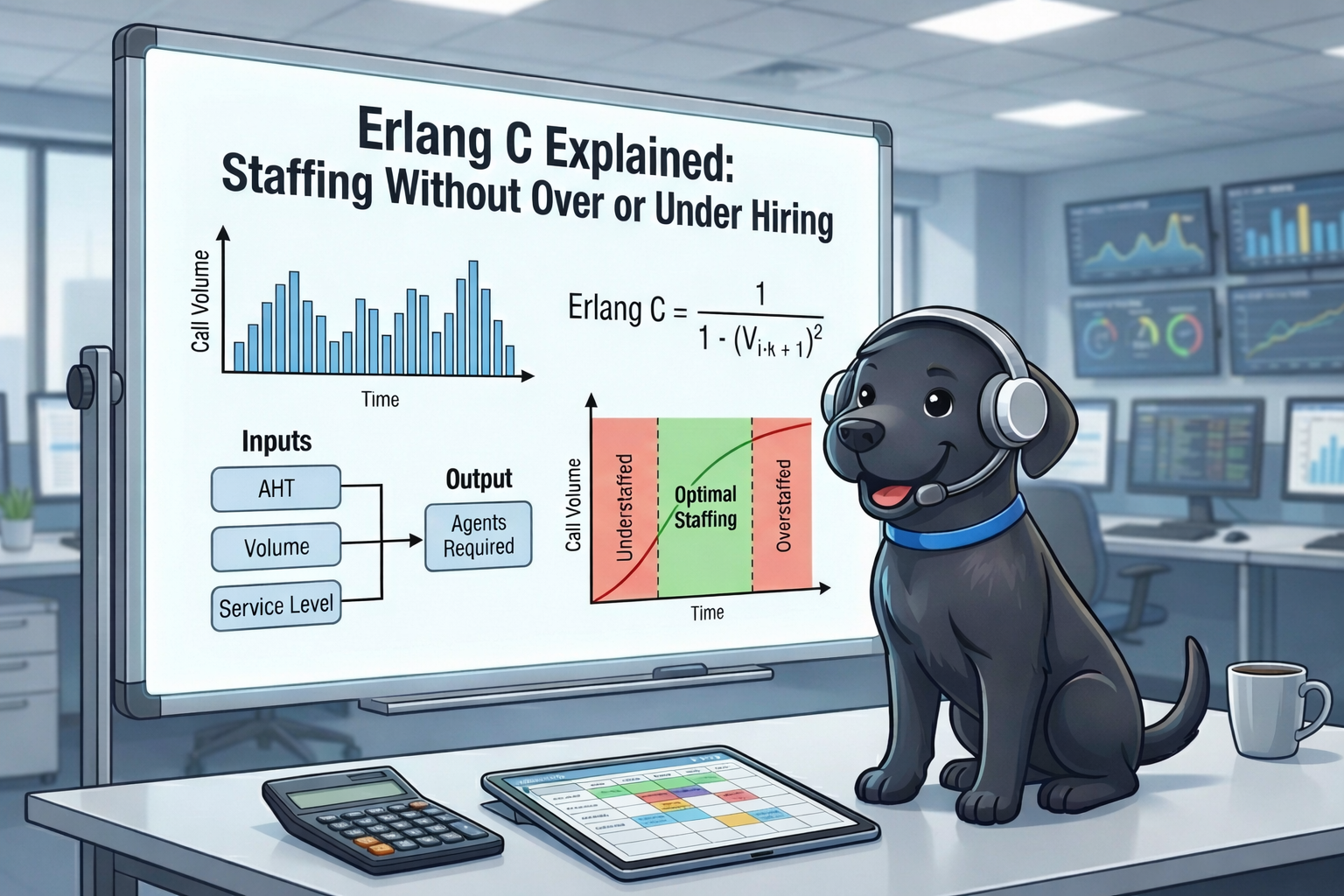
Erlang C Explained: How to Calculate Call Center Staffing Without Over or Under Hiring
Erlang C Explained: How to Calculate Call Center Staffing Without Over or Under Hiring
Erlang C is one of the most widely used staffing models in contact centers. It is also one of the most misunderstood.
I have seen teams trust Erlang C outputs blindly, only to miss service levels during launches, promotions, or rapid growth. I have also seen leaders dismiss it entirely because the real world never matches the model.
The truth sits in the middle.
Erlang C is a powerful tool when you understand what it assumes, what it ignores, and how to use it alongside a realistic forecast. This guide explains Erlang C in plain language and shows how to use it correctly when staffing modern contact centers.
What Is Erlang C
Erlang C is a mathematical formula used to estimate how many agents are required to handle a given volume of contacts while meeting a target service level.
In simple terms, it answers this question:
Given this call volume, handle time, and service level goal, how many agents do I need?
Erlang C is most commonly used for inbound, queue based channels such as phone and live chat.
The Inputs Erlang C Requires
Erlang C relies on a small set of inputs. Each one matters.
- Forecasted contact volume for a specific interval
- Average handle time
- Service level target, such as 80 percent answered within 30 seconds
- Interval length, commonly 15 or 30 minutes
If any of these inputs are wrong or overly optimistic, the output will look precise and still be wrong.
What Erlang C Assumes
This is where many teams get into trouble.
Erlang C assumes:
- Contacts arrive randomly
- Agents are always available when scheduled
- Handle time is consistent
- There is no abandonment before queue
- All contacts are equal in complexity
Real contact centers violate these assumptions every day.
This does not make Erlang C useless. It means you must compensate for reality elsewhere in your model.
What Erlang C Does Not Do
Erlang C does not:
- Forecast volume
- Account for shrinkage
- Model agent skill differences
- Handle multi skill routing
- Adjust for peaky events automatically
This is why strong forecasting and realistic assumptions matter more than the formula itself.
Erlang C and the Peak Interval
Erlang C is most useful when applied to your busiest intervals.
As discussed in Call Center Forecasting 101, staffing decisions are often determined by the busiest interval on the busiest day.
Running Erlang C on averages hides risk. Running it on peak intervals exposes it.
This is where many staffing strategies are stress tested.
If your peak interval requires perfect attendance and perfect handle time to hit service level, you are under staffed.
You can model these scenarios directly using a free Erlang C calculator to see how small changes in volume or handle time affect required headcount.
Base Headcount vs Peak Headcount
Erlang C helps clarify the difference between base and peak staffing needs.
- Base headcount supports normal, steady state demand
- Peak headcount supports spikes from promotions, launches, holidays, or outages
Once peak headcount is visible, teams can decide how to cover it.
- Hire additional full time agents
- Use part time or flexible schedules
- Supplement with BPO partners
- Ask leadership or other teams for temporary help during extreme events
Erlang C does not tell you which option to choose. It makes the tradeoffs visible.
Erlang C Does Not Cover Workforce Planning
Erlang C is often mistaken for a complete workforce planning solution. It is not.
Erlang C calculates how many agents you need logged in and available to handle demand in a specific interval. Workforce planning answers a much bigger question: how many people do you need to hire, train, and retain over time to reliably meet that requirement.
If you base your total headcount plan directly on Erlang C output, you will almost always be under staffed.
That is because Erlang C does not account for:
- Shrinkage from breaks, training, meetings, and time off
- Ramp time for new hires
- Attrition and backfills
- Schedule inefficiencies
- Vacancy risk during growth periods
Workforce planning layers these realities on top of Erlang C requirements. The output of Erlang C should be treated as a net staffing requirement, not a hiring plan.
Teams that skip this step often hit the same pattern: service levels look achievable on paper, but queues spike the moment anything goes wrong.
Strong workforce planning intentionally staffs above Erlang C to absorb uncertainty, especially when scaling, launching new products, or entering peak seasons.
Common Erlang C Mistakes
- Using monthly averages instead of interval level volume
- Ignoring shrinkage and assuming scheduled agents are available
- Locking handle time during periods of change
- Staffing to the average day instead of the peak day
- Assuming precision equals accuracy
Most Erlang C failures are input problems, not math problems.
How to Use Erlang C in Practice
- Build an interval level volume forecast
- Adjust handle time for launches, promotions, and new agents
- Apply realistic shrinkage outside the model
- Run Erlang C on peak intervals first
- Validate results against operational reality
Many teams pair this workflow with an Erlang C calculator to quickly explore service level and occupancy tradeoffs.
Is Erlang C Still Relevant
Yes. Erlang C remains relevant because it provides a fast, transparent way to translate demand into staffing.
It should not be the only input into your workforce strategy, but it is still a foundational one.
Used correctly, Erlang C brings clarity. Used blindly, it creates false confidence.
Final Thoughts
Erlang C is not a forecasting tool. It is a staffing tool.
When paired with a realistic forecast, honest assumptions, and an understanding of peak demand, it helps teams staff confidently without over or under hiring.
The math is simple. The judgment is the hard part.